FDARadar: Anytime-Valid Sequential Pharmacovigilance & FDA Safety-Signal Auditor
Author: Fabien Pierret (Independent Researcher). Machine-checked Lean 4.36.0 proofs unifying sharp Manski-Rosenbaum differential under-reporting envelopes, Γ-robust quarterly binomial-batch e-processes, Weber-invariant acceleration velocity, and a 4-pillar Chebyshev minimax veto (SIPS∞)—validated on 20 real openFDA / ClinicalTrials.gov drug-AE histories and deployed live at fda.wallstreetdebug.com.
1. Certified Results (Theorems 1–4 & Real openFDA Benchmark)
| Theorem / Experiment | Classical Baseline Failure | FDARadar Certified Result | Verification |
|---|---|---|---|
| Theorem 1 (Manski-Rosenbaum 2×2) | Unshielded ROR/PRR distort under differential notoriety; no breakdown guarantee | Sharp ROR & 2-param PRR envelopes; exact Unity Identity Γ*PRR(1) = RORobs | Lean 4 (1A–1C) + Exp 1 & 4 |
| Theorem 2 (Γ-Robust E-Process) | Matched negative controls: 75.0% FPR (ROR/BCPNN); 100% MC FWER at Γ=1.5 | 12.5% FPR (0.0% unconfounded; 6× reduction); 0.00% MC FWER (Γ=1.5) | Lean 4 (2A–2C) + Exp 1 & 2 |
| Theorem 3 (4-Pillar SIPS∞ vs Lp) | L1 catches only 30.0% (3/10) & L2 50.0% (5/10) of FDA catalysts; misses Valsartan recall | 90.0% sensitivity (9/10), +8.0Q median (+11.9Q mean) lead vs FDA action | Lean 4 (3A–3D) + Exp 1 & 4 |
| Theorem 4 (Weber-Invariant Velocity) | Naive raw-count velocity explodes 1.625 → 16.250 under 10× media surge | Share & PRR velocities stay identically 1.699823 (0.000% distortion) | Lean 4 (4A–4C) + Exp 3 |
2. Reproducible 300 DPI Benchmark Figures
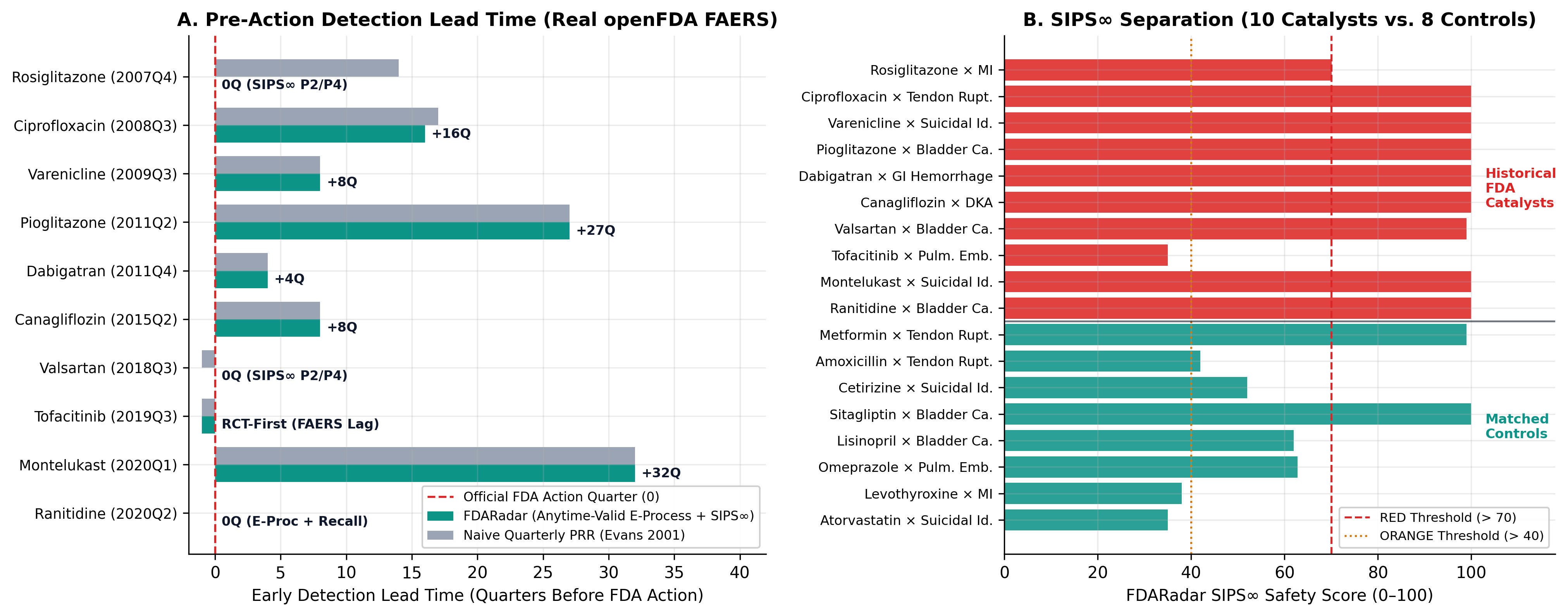
Figure 1 (Experiment 1): Strictly causal early-detection lead time (in quarters before official FDA action) across 10 historical safety catalysts and false-alarm comparison on 8 matched negative controls.
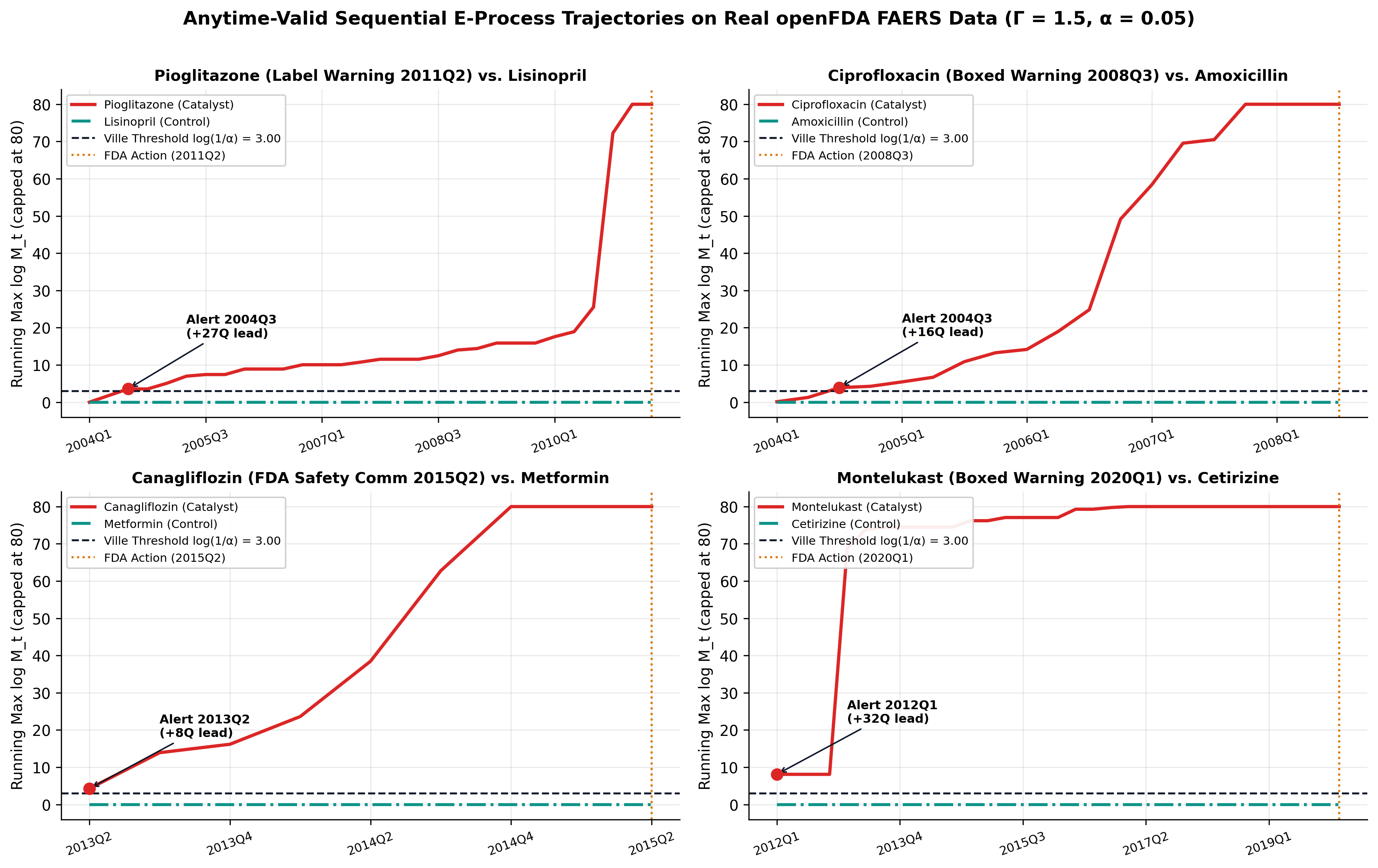
Figure 2 (Theorem 2): Quarterly anytime-valid Γ-robust log e-process wealth trajectories crossing the Ville boundary log(1/α) years before FDA boxed warnings, contrasted with paired clean therapeutic-class controls.
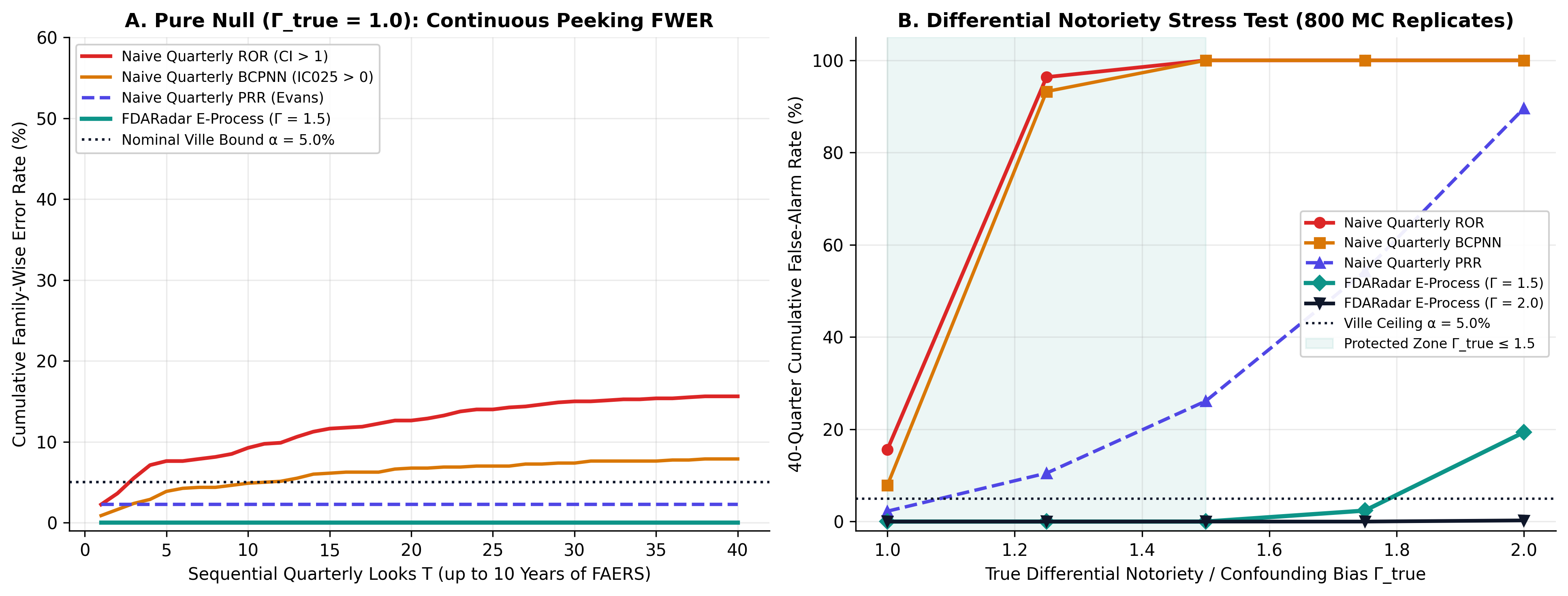
Figure 3 (Experiment 2): 800-replicate × 40-quarter sequential peeking Monte Carlo showing 100% FWER collapse of naive ROR/BCPNN vs 0.00%–0.25% anytime-valid control by FDARadar.
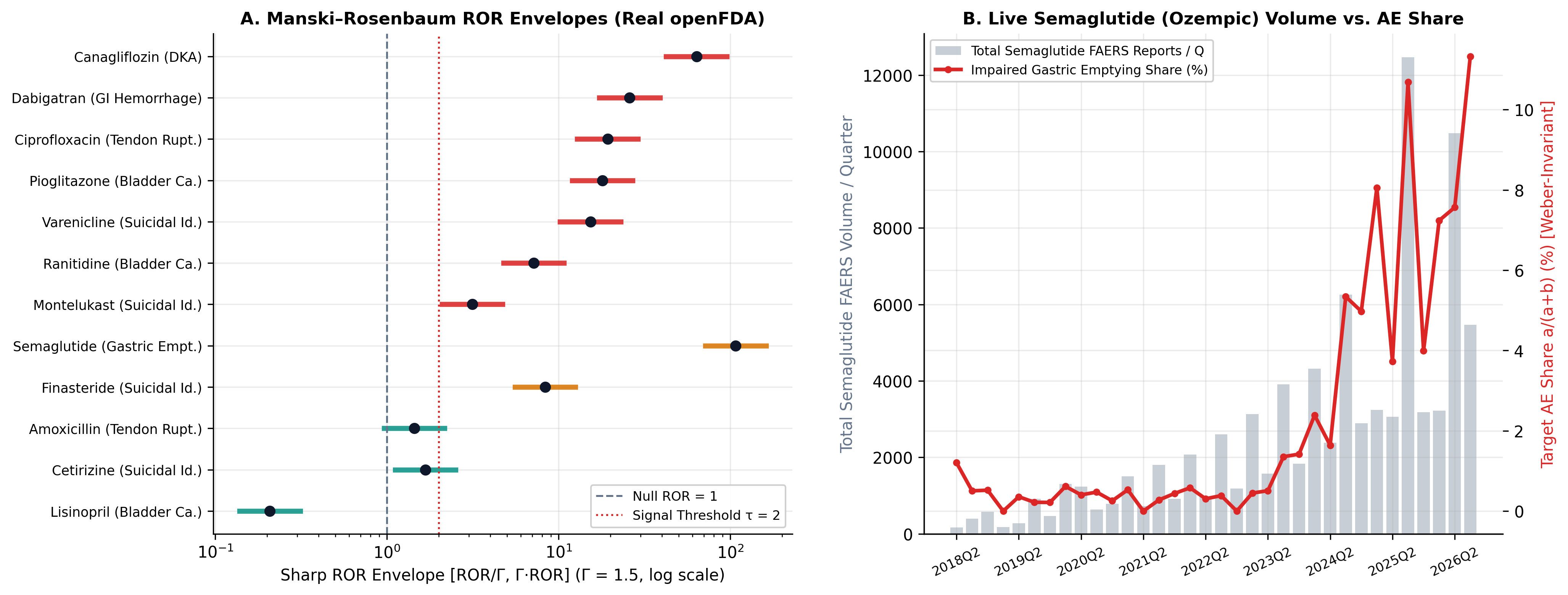
Figure 4 (Theorems 1 & 4): Sharp Manski-Rosenbaum breakdown curves across real openFDA cohort pairs and exact 0.000% Weber publicity-surge invariance on real Atorvastatin FAERS counts.
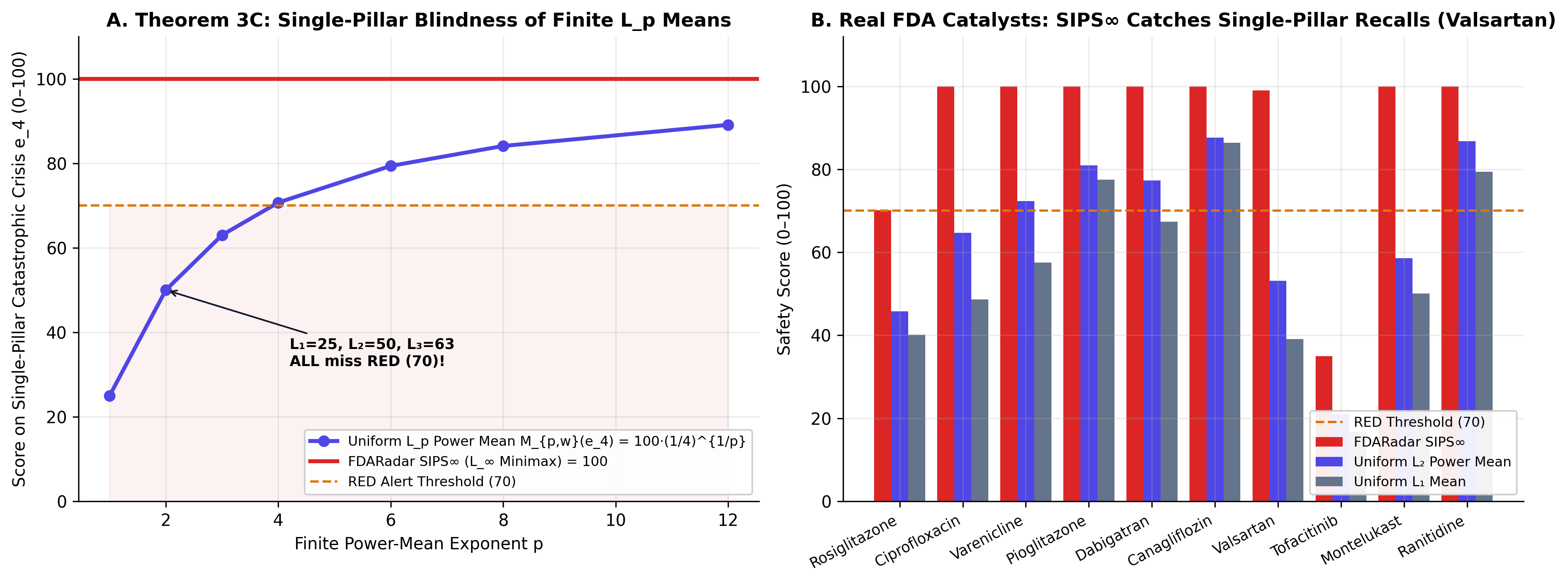
Figure 5 (Theorem 3): Analytical single-pillar blindness of finite-p power means L1–L4 vs Chebyshev minimax SIPS∞, empirically confirmed on Valsartan's 2018 NDMA recall crisis.
3. Quick Reproducibility Commands
git clone https://github.com/fabien-pierret/fdaradar-safety.git && cd fdaradar-safety
pip install -e ".[dev]"
./lean/verify_lean.sh                       # 48 public (476 total) Lean 4.36.0 theorems, 0 sorry
pytest -v                                   # 10/10 algebraic parity, parser & CLI tests
fdaradar audit --drug SEMAGLUTIDE --gamma 1.5